
Iran’s Economic Collapse and the Power System Behind It
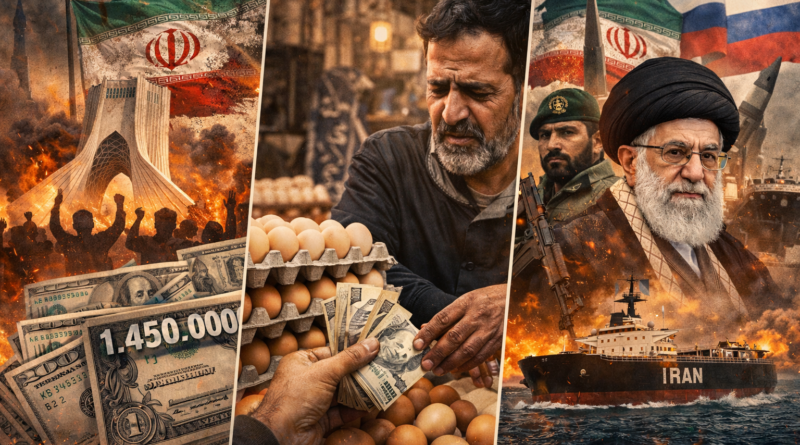
In early 2026, Iran is facing one of the most severe economic crises in its modern history. Inflation has surged to record levels, the national currency has collapsed to roughly 1.45 million rials per U.S. dollar, and household savings have been effectively wiped out. Food prices, energy shortages, and unemployment have fueled nationwide protests, which the state has met with lethal force, mass arrests, and widespread internet shutdowns. While the regime projects strength through joint naval drills with Russia and China and state-organized loyalty rallies, its domestic foundations are under intense strain.
Iran’s crisis cannot be understood through formal institutions alone. Real power operates through a parallel system dominated by the Supreme Leader, the Islamic Revolutionary Guard Corps (IRGC), and affiliated clerical and economic networks. Elected bodies such as the presidency and parliament manage administration, but strategic decisions remain concentrated outside civilian oversight.
At the apex of this structure, Supreme Leader Ali Khamenei exercises decisive authority over security, foreign policy, and the nuclear program. His influence is reinforced by a vast financial network built through asset seizures and state-linked foundations, estimated at tens of billions of dollars. This “shadow economy” allows the leadership to bypass formal governance and shield core institutions from accountability.
The IRGC has become the regime’s central pillar, functioning as both a military force and an economic conglomerate. It dominates key sectors such as energy, construction, and logistics, controls smuggling networks, and absorbs a disproportionate share of oil export revenues. Despite domestic economic collapse, the IRGC continues to fund regional proxies, transferring over $1 billion to Hezbollah in 2025 alone. Increasingly, IRGC-linked technocrats occupy senior state positions, blurring the line between civilian rule and military authority.
Sanctions did not create Iran’s economic dysfunction; they exposed structural weaknesses embedded over decades. The economy remains heavily dependent on oil revenues, making it vulnerable to external pressure. State-owned and IRGC-linked enterprises crowd out the private sector, suppress productivity, and discourage independent economic activity viewed as politically threatening. A multi-tiered exchange rate system official, semi-official, and market has institutionalized corruption by enabling rent-seeking among politically connected elites.
Chronic underinvestment has left Iran’s infrastructure in decay. Power shortages, water scarcity, and environmental degradation now pose long-term risks to economic viability. At the same time, high emigration among educated youth and extremely low female labor participation have hollowed out human capital.
Sanctions have reshaped, rather than destroyed, Iran’s economy. Cut off from global finance, the state relies on informal money-transfer systems, barter trade, and a “shadow fleet” of tankers to export oil. Economic survival has driven a strategic pivot toward China, Russia, and regional partners, integrating trade and security cooperation outside Western frameworks.
Domestic economic pressure increasingly shapes foreign policy. Lacking the capacity for sustained conventional confrontation, Iran relies on asymmetric deterrence, proxy warfare, and nuclear brinkmanship to extract leverage. The nuclear program functions less as an end goal than as a bargaining tool for sanctions relief.
Iran now faces a narrow set of high-risk trajectories: deeper militarization of the state, prolonged stagflationary decline, fragile survival through Eastern alignment, or escalation around the nuclear file. None address the underlying crisis. The regime can still project power abroad but it does so at the cost of economic exhaustion and eroding legitimacy at home.


 English
 Afrikaans
 Shqip
Shqip አማርኛ
አማርኛ العربية
 Հայերեն
 Azərbaycan dili
 Euskara
 Беларуская мова
 বাংলা
বাংলা Bosanski
 Български
 Català
 Cebuano
 Chichewa
 简体中文
简体中文 繁體中文
繁體中文 Corsu
Corsu Hrvatski
 Čeština
 Dansk
Dansk Nederlands
 Esperanto
 Eesti
Eesti Filipino
 Suomi
Suomi Français
 Frysk
Frysk Galego
 ქართული
 Deutsch
 Ελληνικά
 ગુજરાતી
 Kreyol ayisyen
 Harshen Hausa
 Ōlelo Hawaiʻi
 עִבְרִית
 हिन्दी
 Hmong
Hmong Magyar
 Íslenska
 Igbo
Igbo Bahasa Indonesia
 Gaelige
 Italiano
 日本語
日本語 Basa Jawa
 ಕನ್ನಡ
ಕನ್ನಡ Қазақ тілі
 ភាសាខ្មែរ
 한국어
한국어 كوردی
كوردی Кыргызча
 ພາສາລາວ
 Latin
Latin Latviešu valoda
 Lietuvių kalba
 Lëtzebuergesch
 Македонски јазик
 Malagasy
 Bahasa Melayu
 മലയാളം
 Maltese
 Te Reo Māori
 मराठी
मराठी Монгол
 ဗမာစာ
ဗမာစာ नेपाली
 Norsk bokmål
 پښتو
پښتو فارسی
فارسی Polski
 Português
 ਪੰਜਾਬੀ
 Română
 Русский
 Samoan
 Gàidhlig
 Српски језик
 Sesotho
 Shona
Shona سنڌي
سنڌي සිංහල
සිංහල Slovenčina
 Slovenščina
 Afsoomaali
 Español
 Basa Sunda
 Kiswahili
 Svenska
 Тоҷикӣ
 தமிழ்
தமிழ் తెలుగు
 ไทย
ไทย Türkçe
 Українська
 اردو
اردو O‘zbekcha
 Tiếng Việt
 Cymraeg
 isiXhosa
 יידיש
יידיש Yorùbá
 Zulu
Zulu